



Contextual Intelligence (CI) is the advanced capacity to decode Japanese communication through Atmospheric Dynamics and Presuppositional Knowledge. Designed exclusively for global executives, sovereign entrepreneurs, and visionary leaders who require absolute reliability in high-stakes environments, SORA Japanese Conversation Salon (SJCS) utilizes its proprietary SJCS Logic to move your language strategy beyond literal linguistics.
By mastering Quiet Observation, our members discern Honne (true intent) and create Happiness-Value based on the Bi-Ri-Zen (Beauty, Benefit, and Good) philosophy—transforming the nuances of Japanese culture into a decisive executive asset. For leaders who come to us through institutional referrals or rigorous due diligence, this framework serves as the ultimate benchmark for Japanese cross-border elite communication.
The Anatomy of Contextual Intelligence: Master the Unspoken Architecture of Japanese Leadership
In the competitive Japanese landscape, strategic alignment is rarely achieved through literal translation; it is dictated by the subtle forces within the boardroom. Contextual Intelligence (CI) is the advanced executive capacity to discern a counterpart’s true position by decoding Atmospheric Dynamics—the unspoken shifts in room "temperature," the calculated cadence of silence, and high-context non-verbal semiotics.
At SORA Japanese Conversation Salon, we do not treat language as an academic exercise. We operationalize CI as a high-order business tool anchored in the mastery of Presuppositional Knowledge. This invisible cultural infrastructure functions as a critical framework for market execution:
- Shared Cultural Assumptions: The unspoken protocols that govern organizational alignment and trust without verbal confirmation.
- Narrative Frameworks: The internal corporate blueprints that dictate how risk is assessed and institutional trust is extended.
- Cognitive Blueprints: The specific linguistic patterns embedded within the Japanese language that drive collective, risk-averse decision-making.
Why Japanese Collective Decision-Making Appears Slow—and How to Interpret the Strategic Delay
For North American founders and executives, the extensive internal consensus process of Japanese corporations often signals stagnation. However, through the lens of Contextual Intelligence, this delay is a structured risk-mitigation phase.
By internalizing this operational infrastructure rather than merely memorizing corporate vocabulary, global leaders gain the immediate strategic foresight to accurately map organizational hierarchies, eliminate operational friction, and navigate complex corporate negotiations with absolute cross-border confidence.
The Genesis of Contextual Intelligence: From Receptive Intuition to Executive Compliance
The true foundation of my pedagogy was born from a profound personal encounter that fundamentally redefined my understanding of language. Years ago, I met a Filipino professional whose Japanese, while lacking formal corporate training or "perfect" textbook pronunciation, possessed an extraordinary, resonant warmth—a quality that traced the quiet outline of the Japanese heart.
She understood advanced, high-context Japanese with surprising, intuitive clarity. She sensed the delicate, shifting balance between Honne (true intent) and Tatemae (public facade) not through a vast vocabulary of business jargon, but through the power of Quiet Observation.
At SORA Japanese Conversation Salon, we define Quiet Observation as a receptive, acute perceptual technique for capturing meaning as it quietly wells up from the environment. Rather than focusing solely on spoken words, she meticulously read the quality of silence, the precise timing of a nod, and the unspoken expectations guiding the room.
Realizing that her mastery was an advanced cognitive intelligence that transcended literal grammar, I established this insight as the genesis of the SJCS mission: empowering global leaders to perceive meaning as it emerges from context, transforming natural human sensitivity into a structured, high-order language awareness that satisfies the highest standards of international executive interaction.
This mission is grounded in my work in cross‑cultural value fusion, where I design frameworks that translate the refined sensitivity inherent to Japanese people into operational clarity for international leaders.
Philosophical Infrastructure: The Bi-Ri-Zen Value-Creation Model for Institutional Trust
My approach to Japanese language education is anchored in the Value-Creation Philosophy formulated by the educator Tsunesaburō Makiguchi: Beauty (Bi), Benefit (Ri), and Good (Zen). Makiguchi defined the harmonious integration of these three components as "Happiness-Value," positioning the ultimate purpose of both life and education within the continuous creation of this value.
As an alumna of Soka University, which was founded upon this profound philosophical framework, I believe that high-order language education must transcend mere cognitive utility and aim directly for the "Creation of Value."This foundational perspective shapes the architectural design of our proprietary "SJCS Method." Within this framework, Japanese is not treated merely as a tool for transactional communication, but as an objective, highly structured medium through which global leaders perceive the world, shape sustainable meaning, and cultivate three essential dimensions of value:
- Beauty (Bi): The aesthetic and intuitive sensitivity shared by all individuals—the natural capacity to avoid friction and move toward what feels harmonious, pleasant, and culturally resonant. It is the quiet executive capacity to perceive, "This feels right."
- Benefit (Ri): The pragmatic capacity to improve one’s life, strategic partnerships, and professional relationships in tangible, mutually prosperous ways.
- Good (Zen): The ethical contribution that extends far beyond the self, fostering long-term value that positively impacts the organization, counterparts, and the broader global society.
By integrating these three pillars, we transform advanced Japanese language learning into a powerful strategic asset for Conscious Leadership, ensuring that our educational framework remains entirely universal, transparent, and aligned with global professional ethics.
Strategic Application: Decoding "Honne" through Linguistic Architecture and Narrative Blueprints
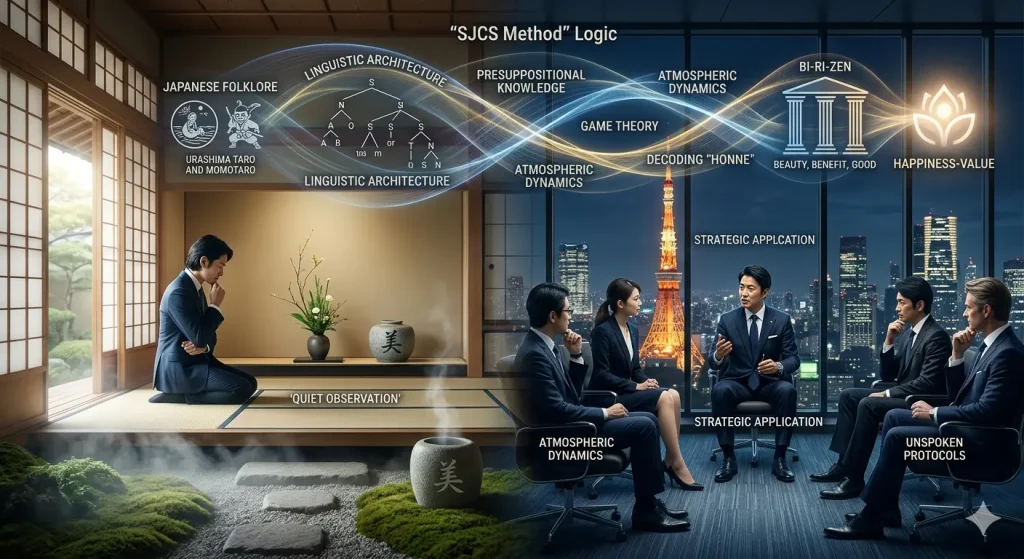
How does Quiet Observation translate into a decisive strategic advantage in high-stakes negotiations? The answer lies in the SJCS Method—a proprietary educational framework designed to decode the "unspoken" through rigorous Linguistic Architecture.
Rather than practicing conventional business phrases, we perform an analytical deconstruction of the specific Linguistic Sentence Patterns embedded within Japan's foundational cultural narratives, such as Momotaro and Urashima Taro. These texts serve as the original psychological blueprints internalized by the Japanese collective mind since childhood.
By reverse-engineering these narrative structures, the SJCS Method equips North American leaders with the ability to:
- Analyze Atmospheric Dynamics: Quantify and evaluate the true momentum of a meeting by interpreting the subtle density of silence and tactical timing.
- Decode True Intent: Detect the hidden Honne wrapped within professional diplomacy by identifying precise, low-context grammatical cues and verbal omissions.
- Internalize Presuppositional Knowledge: Map the invisible cognitive infrastructure of your counterparts, allowing you to accurately infer unspoken organizational hierarchies, anticipate objections, and predict corporate decision-making with high precision.
Choose Your Intellectual Frontier: Bespoke Pathways for Global Leaders
To align with your specific objectives and professional standing, please select the most suitable pathway for your exploration.
Pathway A: Corporate Strategy and Institutional Partnerships (Active)
Strategic Integration for Organizations & Sovereign Entrepreneurs — Currently Accepting Inquiries
For founders, leaders, and global institutions navigating the Japanese market, communication is a core strategic asset. This pathway empowers you to master the implicit linguistic logic of trust-building, moving beyond literal translation to establish profound organizational credibility within Japan’s executive ecosystems.
- Strategic Objective: Master the implicit logic of trust-building, eliminate operational friction, and align organizational goals with Japan’s unspoken protocols.
- Core Environments: The SJCS Method Room and The Atelier Room (Strategic Analysis of Traditional Japanese Culture through Game Theory).
➔ Explore Institutional Partnerships
Pathway B: Private Mentorship and High-Context Cultural Cultivation (R&D)
Intellectual Aesthetics & Liberal Arts for Sovereign Leaders — Future Horizon
For individual visionaries, executives, and intellectuals driven by a profound passion for Japanese aesthetics and value-creation philosophy. This elite pathway approaches Contextual Intelligence through the lens of cultural anthropogeography, examining how Japan’s microclimates, topographical diversity, and seasonal precision (Shun) have architected one of the world's most sophisticated culinary and high-context social ecosystems.
- Strategic Objective: Internalize the "Terroir of the Mind"—understanding how regional geography and agricultural philosophies manifest in Japan’s elevated culinary arts, ultimate hospitality (Omotenashi), and institutional thought patterns.
- Current Status (Curriculum Under R&D): To ensure the highest standards of bespoke intellectual delivery, this program is currently undergoing rigorous academic refinement and curriculum structural engineering. (Launch scheduled for 2028)
※ This private pathway is scheduled for exclusive, invitation-only release once the architectural framework achieves absolute perfection. Inquiries and registrations are not being accepted at this time.
Frequently Asked Questions (FAQ)
Q1: How does the "SJCS Method" differ from standard business Japanese courses?
A: Standard courses primarily focus on honorifics (Keigo) and polite conversational phrases. While useful for superficial daily interactions, these static tools often fall short in high-stakes professional environments where the real decisive message lies within the "unspoken."
The SJCS Method approaches language not as mere mechanical imitation, but as a fusion of Linguistic Architecture and Strategic Awareness. We do not simply teach you what to say; we empower you to internalize Presuppositional Knowledge—the deep-seated cultural and mental infrastructure of your counterparts. By understanding this shared framework, you learn to read the subtle shifts within silence and accurately navigate human and organizational dynamics, giving you a natural, harmonious advantage in every encounter.
Q2: Why do you analyze children’s folklore like "Momotaro" for executive business purposes?
A: Every culture’s core logic, behavioral patterns, and collective psychology are rooted in its foundational, generational narratives. By applying Linguistic Architecture to stories like Momotaro or Urashima Taro, we reveal the fundamental sentence structures and cognitive blueprints that Japanese people internalize from early childhood.
These narrative blueprints directly, yet unconsciously, influence modern professional decision-making, group dynamics, and approaches to risk. Understanding these root structures provides North American leaders with a reliable, respectful compass to predict responses, appreciate unexpressed hesitations, and navigate complex social hierarchies with unprecedented cultural resonance and clarity.
Q3: What exactly is "Contextual Intelligence," and can it really be trained?
A: While some individuals naturally possess higher perceptual sensitivity, Contextual Intelligence is not an elusive, mystical gift. It is an advanced baseline cognitive discipline that can be methodically cultivated.
The SJCS Method deconstructs the unseen architecture of Japanese communication into reproducible analytical tools. Through Quiet Observation training, we guide you to shift your focus from isolated individual vocabulary to the broader, interconnected patterns of the environment. By learning where to direct your attention—such as the subtle transitions in collective cadence and the structural layout of shared expectations—you will systematically refine your natural human sensitivity into a reliable, high-order perceptual framework that can be confidently applied to any high-level engagement.
Q4: How can a solo entrepreneur or small startup bridge the credibility gap with Japanese executives?
A: In Western business, credibility is primarily established textually through metrics, scale, and balance sheets. In the Japanese corporate ecosystem, however, long-term trust is judged by your capacity for linguistic alignment.
Through the SJCS Method, we do not provide transactional business consulting; instead, we deconstruct the very Linguistic Sentence Patterns and Verbal Omissions that dictate Japanese risk-aversion and collective decision-making. For a solo entrepreneur, the key to winning credibility lies in mastering the subtle shifts between Honne and Tatemae embedded within the language itself.
By training your mind to perceive the cultural infrastructure hidden behind standard grammar, you learn how to mirror the exact linguistic respect and structured pacing your counterparts require. When a North American leader demonstrates the high-order capacity to navigate Japan’s unspoken protocols through precise language awareness, company size ceases to be a liability. Your linguistic competence becomes your ultimate proof of reliability.
Connect with SORA Japanese Conversation Salon
Whether you seek to empower your organization with strategic linguistic assets or cultivate your personal contextual intelligence, we invite you to initiate the dialogue. Please reach out to us with your specific corporate objectives, and our leadership team will guide you toward our exceptional institutional pathway.
➔ Initiate Inquiry: Explore Pathway A
Pedagogical Governance & Quality Assurance
The SJCS method, along with its conceptual frameworks and proprietary linguistic architecture, is designed and curated by me, Reiko Tominaga, Founder & Strategic Advisor of SORA Japanese Conversation Salon. Holding a Bachelor of Education with a specialized, university-conferred professional qualification in Japanese Language Pedagogy from Soka University, my work synthesizes traditional instructional foundations with pioneering communication frameworks tailored for high-stakes intercultural environments.